Health & Wellness
Stress Management Guide for Real Humans
A practical stress management guide for when breathing advice is not enough: quick resets, smaller lists, and better boundaries.
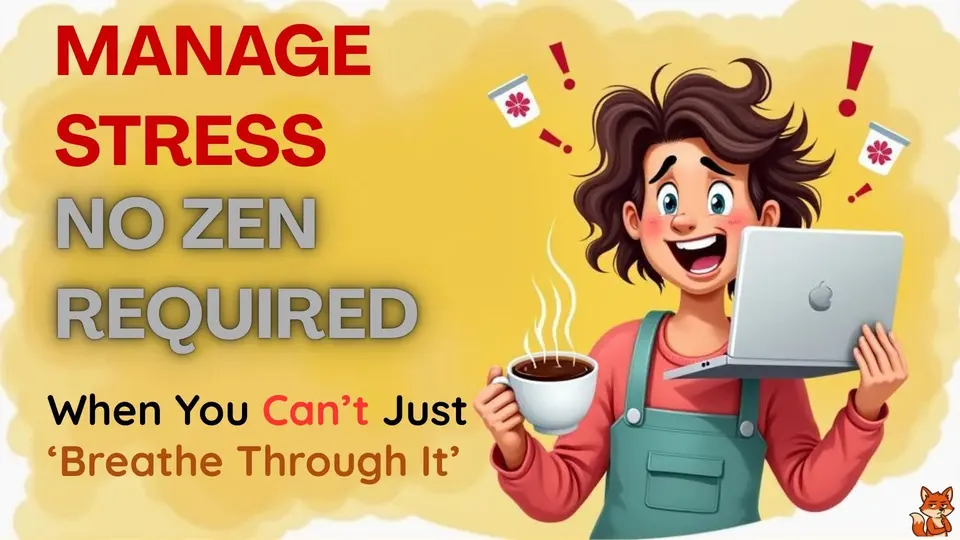
Most stress advice becomes useless at the exact moment you need it.
“Just breathe.”
Sure.
And while we are inventing miracles, maybe the inbox can do yoga and the deadline can develop manners.
Real stress management has to work when you are already tense, behind, overstimulated, under-slept, and one small inconvenience away from becoming a problem in a group chat.
So this guide is not about becoming perfectly calm.
It is about becoming recoverable.
You get hit.
You reset faster.
You reduce the repeat stressors where you can.
You stop treating every hard day as proof that you are bad at being alive.
Good. Let us be practical.
First, Sort The Stress
Not all stress needs the same tool.
Stop throwing breathing exercises at everything.
The move: Name the type of stress before choosing the fix.
Acute Stress
This is the spike.
Bad email.
Messy call.
Kids yelling.
Laptop freezing right before a meeting.
You need: A fast reset.
Chronic Stress
This is the background hum.
Too much work.
No margin.
Money pressure.
Always being needed.
You need: Boundaries, recovery, and fewer open loops.
Avoided Stress
This is the thing you are not looking at.
The message you have not answered.
The bill you have not opened.
The decision you keep pushing into tomorrow.
You need: One tiny action.
Do not use the wrong tool.
Meditation will not pay the bill.
A to-do list will not regulate a panic spike.
Name the stress first.
Emergency Reset: The 3-2-1 Grounding Drill
When your brain is static, make it count the room.
The move:
- Name 3 things you can see.
- Name 2 things you can hear.
- Touch 1 physical thing and describe it.
That is it.
Why: Stress pulls you into threat-story mode. This pulls attention back into the room.
Do it while walking to the bathroom.
Do it before replying.
Do it with your camera off.
Nobody needs to know.
If anxiety is the main issue, anxiety tools that do not tell you to just breathe goes deeper into this lane.
The Five-Minute Vent
Some stress needs to leave your head before it becomes useful information.
The move: Set a five-minute timer and dump the complaint somewhere safe.
Use:
- A private note
- A voice memo
- A trusted friend
- A blank document you delete afterward
Rules:
- No editing
- No fixing
- No sending while heated
- Stop when the timer ends
Why: Venting without a container can become rumination. Venting with a timer can clear enough space to think.
After the timer, write one line:
What is the next useful action?
Not the perfect action.
The next useful one.
The Good-Enough List
Stress gets worse when every task has the same emotional volume.
Your brain treats “reply to text” and “finish tax forms” like equal citizens.
Rude and inaccurate.
The move: Split the day into three lists.
Must Do
Maximum three items.
These are the things that create real consequences if ignored.
Should Do
Useful, but movable.
This is where most tasks live.
Not Today
This list is not laziness.
It is protection.
Put the noise somewhere it cannot keep tugging your sleeve.
If you keep putting everything in Must Do, you are not planning.
You are panicking in bullet points.
Reduce Stress At The Source
Fast resets are useful.
But if the same problem keeps punching you in the schedule, you need source control.
Email Stress
The move: Check email at set times.
Start with three windows:
- Morning
- After lunch
- Late afternoon
If your job requires faster response, fine. Adjust.
But do not pretend random inbox checking is focus.
It is stress polling.
People Stress
The move: Stop answering every request in real time.
Use:
“Let me check and get back to you.”
That sentence is a fence.
Use it.
For the deeper version, boundary-setting strategies is the better next read.
Availability Stress
The move: Make your unavailable time visible.
Calendar block.
Status message.
Phone away.
Door closed if you have one.
Headphones if you do not.
If the problem is work leaking into every hour, read the real cost of always being available. Stress loves open doors.
Build Stress Capacity Without Becoming A Wellness Project
You do not need a 14-step morning routine.
You need a few boring supports that make you less fragile.
Sleep
Pick one improvement.
- Same wake time most days
- Dimmer lights at night
- Phone out of reach
- Caffeine cutoff
- Clothes ready for tomorrow
One.
Do not build a palace of sleep rules you abandon by Thursday.
Movement
Move enough that stress has somewhere to go.
Not punishment.
Not transformation.
Just movement.
Walk.
Stretch.
Do ten squats.
Take the stairs.
Shake out your shoulders between calls.
Tiny counts if tiny happens.
Food And Water
Stress plus no food makes every problem look bigger.
Drink water.
Eat something with protein.
Do not make a moral essay out of lunch.
Take care of the machine.
Then make decisions.
When Stress Is Actually Avoidance
Sometimes you are not stressed because life is too much.
You are stressed because one thing is sitting there untouched, getting louder.
The move: Make the avoided thing smaller.
Examples:
- Open the bill. Do not solve it yet.
- Draft the reply. Do not send it yet.
- Name the decision. Do not decide yet.
- Write the first sentence. Do not finish the document yet.
This is not weakness.
This is how stuck things become movable.
Action shrinks the scary shape.
Avoidance feeds it.
What Not To Do
Do not turn stress management into another performance.
You do not need to become the calmest person in the room.
Do not shame yourself for needing simple tools.
Simple tools work because stressed brains need handles, not philosophy.
Do not compare your stress to someone else’s.
Different nervous systems. Different loads. Different support.
Do not ignore repeated stress patterns.
If the same thing breaks you every week, it is not a random bad day. It is a system problem.
Do not use productivity to avoid rest.
Sometimes the next action is sleep. Annoying, but true.
For the energy side of this, use energy management. Stress drains the tank. Energy work helps you stop pretending the tank is infinite.
The One-Week Stress Reset
Do not overhaul your life.
Run a one-week experiment.
Day 1
Make the three-list system.
Must Do. Should Do. Not Today.
Day 2
Try the 3-2-1 grounding drill once.
Before you need it is better.
Day 3
Set one email or message-checking window.
One.
Day 4
Take a five-minute vent, then choose one useful action.
Day 5
Move for 10 minutes.
Walk, stretch, anything.
Day 6
Make one boundary visible.
Calendar, message, door, headphones, whatever fits your life.
Day 7
Review:
- What lowered the noise?
- What was fake productivity?
- What keeps repeating?
- What needs help from another person?
That last question matters.
If stress is severe, persistent, or tied to panic, trauma, self-harm thoughts, or feeling unsafe, get professional support. This guide is a toolkit. It is not a replacement for care.
Do This Now
Pick one:
- 3-2-1 grounding drill
- Five-minute vent
- Three-list day
- One visible boundary
- Ten-minute walk
Not all five.
One.
Stress management is not a personality upgrade.
It is a set of handles.
Grab one handle today.
Then build the next one when your brain has room.
Advertisement